The research behind each herb
How Does Honey Peak Gelatin Work? What Each Extract Is Studied For
Honey Peak Gelatin relies on six plant extracts in a 121 mg daily blend, with no caffeine or vitamins. Four of them, horse chestnut, butcher's broom, gotu kola and grape seed, are mostly studied for leg vein comfort at doses above what this blend can hold. No study has tested the drops themselves.
How is Honey Peak Gelatin supposed to work?
Honey Peak Gelatin is made to support daily energy with six plant extracts, not with caffeine or vitamins. The label calls it "Daily Energy Support*", and the star means the claim has not been evaluated by the FDA.
No study has tested Honey Peak Gelatin itself. What exists is research on each herb alone, usually at a much larger dose and in a specific group of people. So the honest way to explain how the drops work is to look at each extract, what it is studied for, and how much of it could be in a 2 ml serving.
What does the label say the drops support?
The bottle and brand panels name three areas: energy, vitality and stamina. They present these as general support for adult men, not as a fix for any condition.
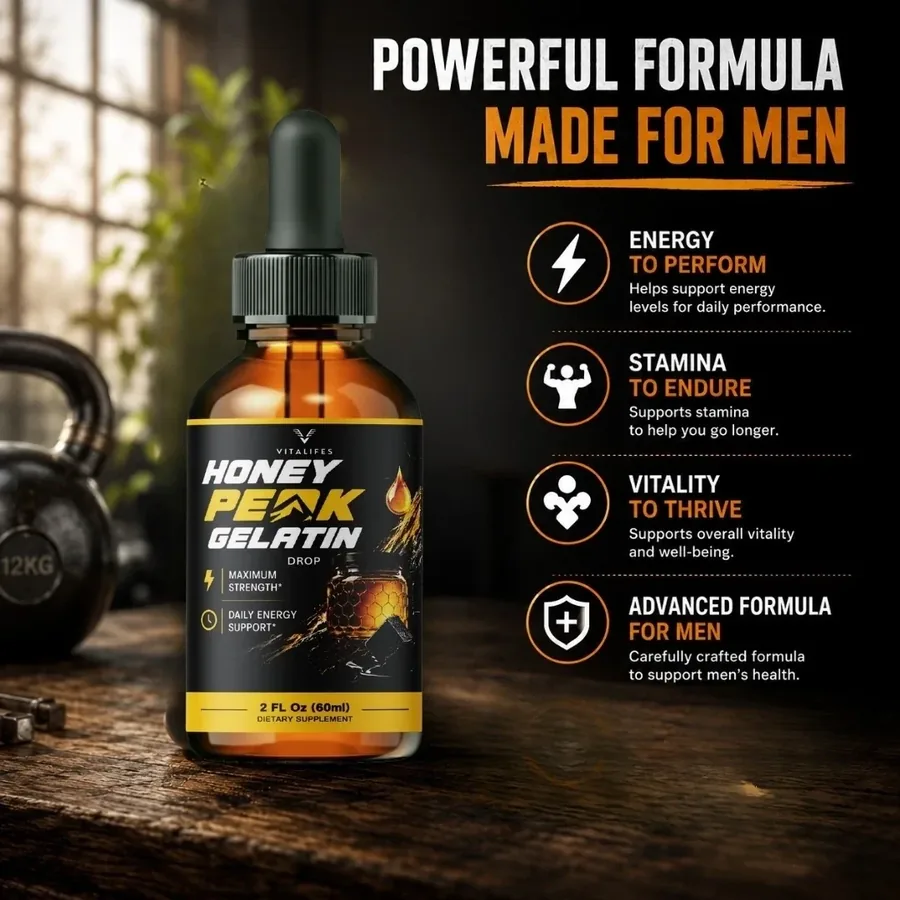
- "Energy to perform: helps support energy levels for daily performance"
- "Stamina to endure: supports stamina to help you go longer"
- "Vitality to thrive: supports overall vitality and well-being"
- "Advanced formula for men: carefully crafted formula to support men's health"
These are the brand's words. They describe goals, not tested outcomes. None of them is backed by a trial of this product.
What each extract is studied for
Each herb has its own body of research. Most of it is small, and most of it is not about energy in healthy men.
Gotu kola leaf
Gotu kola is the first and largest ingredient in the blend. Its main human research is on a triterpene fraction for leg vein symptoms, at 60 to 180 mg a day (Chong & Aziz, 2013). The review found some benefit for swelling and discomfort, but the trials were small. The label does not say whether this extract is standardized to triterpenes.
Chinese hawthorn fruit
Hawthorn has a long history of use for the heart. NCCIH describes the human evidence as limited (NCCIH). In 2024 the FDA also warned about products sold as hawthorn that held toxic yellow oleander instead. This label names Chinese hawthorn fruit, but it gives no test result for identity.
Horse chestnut
Horse chestnut seed extract has the most research of any herb in the bottle. A Cochrane review found it helped leg pain and swelling in people with chronic venous insufficiency (Pittler & Ernst, 2012). Those trials used extracts standardized to give about 100 to 150 mg of aescin a day. Here, the whole horse chestnut share is 40 mg at most.
Motherwort
Motherwort is a mint-family plant used in European and Chinese herbal traditions. Reviews of its chemistry and effects rely mostly on lab and animal work (Wojtyniak et al., 2013; Shang et al., 2014). There is no settled human dose to compare with.
Butcher's broom root
Butcher's broom is a small shrub whose root holds compounds called ruscogenins. A 12-week trial gave a standardized preparation twice a day to people with chronic venous insufficiency and saw less leg swelling than placebo (Vanscheidt et al., 2002). A later Cochrane review of vein products rated the overall evidence as moderate to low (Martinez-Zapata et al., 2020).
Grape seed
Grape seed extract is rich in plant compounds called proanthocyanidins. A review of 16 trials found small drops in blood pressure, at doses from the low hundreds up to 2,000 mg a day (Zhang et al., 2016). NCCIH notes that the evidence for most other uses is weak (NCCIH). In this blend, grape seed is the last and smallest item, 20 mg at most.
Studied doses next to the most the blend can hold
For every herb with a known study dose, the ceiling in Honey Peak Gelatin is lower. The ceilings come from the rule that blend ingredients are listed from most to least by weight.
| Extract | Main research focus | Dose in studies | Most per day here | Source |
|---|---|---|---|---|
| Gotu kola (leaf) | Leg vein comfort in chronic venous insufficiency | 60 to 180 mg a day of a triterpene fraction | 121 mg at most, likely far less | Chong & Aziz, 2013 |
| Chinese hawthorn (fruit) | Heart and circulation, mostly other hawthorn species | Human evidence is limited | 60.5 mg at most | NCCIH |
| Horse chestnut | Leg vein comfort in chronic venous insufficiency | About 100 to 150 mg of aescin a day | 40 mg of extract at most | Pittler & Ernst, 2012 |
| Motherwort | Traditional use; mostly lab and animal work | No settled human dose | 30 mg at most | Wojtyniak, 2013 |
| Butcher's broom (root) | Leg vein comfort in chronic venous insufficiency | Standardized preparation, twice daily for 12 weeks | 24 mg at most | Vanscheidt, 2002 |
| Grape seed | Blood pressure and circulation | Low hundreds up to 2,000 mg a day | 20 mg at most | Zhang, 2016 |
A ceiling is the most an extract could be, not what it is. If all six were split evenly, each would be about 20 mg a day. See the full ingredients breakdown for how each ceiling is worked out.
Why research on leg veins does not equal daily energy
Most of the good trials behind these herbs were done in people with a medical problem in their leg veins. A result in that group does not tell us what happens in a healthy man who wants more steady energy.
Different people
Trial volunteers had chronic venous insufficiency. Healthy men without that condition were not the target group.
Different doses
Studies used standardized extracts at set amounts. This label gives one total for six herbs.
Different outcomes
Trials measured leg swelling, pain or blood pressure. None measured daily energy or stamina.
This does not mean the drops do nothing. It means the research cannot predict what you will notice. The label has no caffeine, no B vitamins and no other classic energy nutrient. Any effect would have to come from the herbs, at small amounts, over time.
How would you know if it works for you?
Track a few simple things for several weeks, and judge the drops against your own starting point. Energy is affected by sleep, food, stress and exercise, so change one thing at a time.
Write down a baseline
Before day one, rate your usual afternoon energy from 1 to 10 for a week.
Take the label dose
1 ml in the morning and 1 ml later in the day, every day. Our dosing guide has a simple schedule.
Keep the rest steady
Try to hold sleep, caffeine and training close to normal so the comparison is fair.
Check in at set points
Rate again at weeks 2, 4 and 8. Decide inside the 60-day money-back window.
The order desk reports that most reviewers say they waited 4 to 8 weeks before they judged the drops. Our results timeline covers what that means for the refund window.
Can the extracts affect medicines?
Yes, some may. The herbs that act on circulation can also add to drugs that do the same thing.
Horse chestnut and grape seed may add to blood thinners, which matters before surgery too. Hawthorn and butcher's broom may interact with heart or blood pressure medicines, and motherwort and gotu kola may add to sedatives. Ask your doctor first if you take any of these. The side effects page has the details.
How Honey Peak Gelatin works: common questions
Is there a clinical study on Honey Peak Gelatin?
Not that we know of. The research is on single herbs, each studied alone and usually at a larger dose.
Does Honey Peak Gelatin work like an energy drink?
No. It has no caffeine or other stimulant, so it will not give a quick lift. Any effect would come from the herbs over time.
Which extract has the strongest research?
Horse chestnut seed extract, for leg pain and swelling in chronic venous insufficiency. Those trials used about 100 to 150 mg of aescin a day.
Why are circulation herbs in an energy product?
The brand does not explain its choice. Many of these herbs have a long traditional use, and several are studied for blood flow in the legs.
How long should I try it before I decide?
Most order-desk reviewers say they waited 4 to 8 weeks. Keep an eye on the 60-day money-back window while you test it.
Sources for this page
- Chong NJ, Aziz Z. A systematic review of the efficacy of Centella asiatica for improvement of the signs and symptoms of chronic venous insufficiency. Evid Based Complement Alternat Med, 2013. Source
- National Center for Complementary and Integrative Health. Hawthorn. Updated April 2025. Source
- Pittler MH, Ernst E. Horse chestnut seed extract for chronic venous insufficiency. Cochrane Database of Systematic Reviews, 2012. Source
- Wojtyniak K, Szymański M, Matławska I. Leonurus cardiaca L. (motherwort): a review of its phytochemistry and pharmacology. Phytother Res, 2013. Source
- Shang X, et al. Leonurus japonicus Houtt.: ethnopharmacology, phytochemistry and pharmacology of an important traditional Chinese medicine. J Ethnopharmacol, 2014. Source
- Vanscheidt W, et al. Efficacy and safety of a Butcher's broom preparation (Ruscus aculeatus L. extract) compared to placebo in patients suffering from chronic venous insufficiency. Arzneimittelforschung, 2002. Source
- Martinez-Zapata MJ, et al. Phlebotonics for venous insufficiency. Cochrane Database of Systematic Reviews, 2020. Source
- Zhang H, et al. The impact of grape seed extract treatment on blood pressure changes: a meta-analysis of 16 randomized controlled trials. Medicine (Baltimore), 2016. Source
- National Center for Complementary and Integrative Health. Grape Seed Extract. Updated February 2025. Source
Keep reading
Ready when you are
Order Honey Peak Gelatin from the authorized US retailer
30 servings in every 2 fl oz bottle, 1 ml twice a day. 60-day money-back guarantee. A real person at +1 (302) 200-3480 for orders, tracking and refunds.