Evidence check
Does Honey Peak Gelatin Really Work? What the Evidence Can and Cannot Say
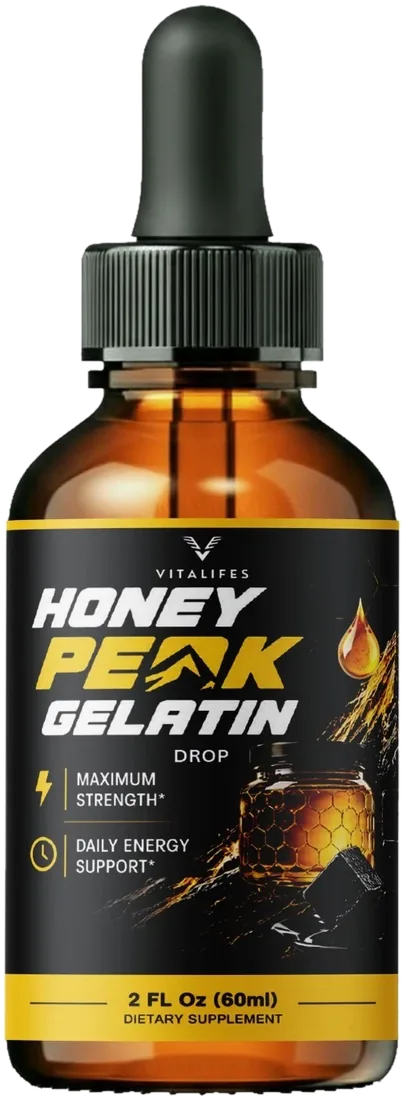
Nobody can promise that it works. No study has tested this exact blend. The six extracts were studied one at a time, at larger amounts than a 121 mg blend can hold, and mostly for leg vein comfort. Order-desk reviewers say they waited 4 to 8 weeks. Judge it yourself inside the 60-day window.
Key facts
- The label claim is “Daily Energy Support”, a support claim and not a promise.
- We found no published study of this exact blend.
- Most research on four of the six extracts looked at leg vein comfort in people with chronic venous insufficiency.
- One serving is 2 ml and holds one 121 mg blend. Research doses for single extracts were usually higher.
- Reviewers quoted by the order desk mostly gave it 4 to 8 weeks before making up their minds.
- You have 60 days to ask for your money back, so set a decision date early.
- Like every dietary supplement, it is not FDA approved, and it makes no disease claim.
What would “work” mean for a daily energy drop?
Two facts about this bottle pull in opposite directions. The front label says “Daily Energy Support*”. The panel lists no caffeine and no B vitamins. So the first job is to decide what you would count as a result.
Support wording is not a promise of a change. It is a description of the goal the product is sold for. The brand panels add three more support lines, for energy, vitality and stamina. Those are the brand's words and not test results.
Pick one thing you can measure before you start. A daily 1 to 10 rating of your afternoon energy is enough. Without a baseline, any feeling after a few weeks is hard to trust.
Has Honey Peak Gelatin itself been tested?
We found no published study of this exact blend. No trial, no pilot and no lab paper that names it. The research we can point to was done on single extracts.
The lab side is also thin. The seller names the current lot, HON-26/HO-7986, and a certificate of analysis reference, HON-7986-26-HO. The report behind the code is not published, so we cannot say what was tested.
That does not prove the drops do nothing. It means a claim of “proven” would be unfair. The honest position is unknown.
What do the studies on the six extracts show?
Here is what the studies we cite examined, set beside the most each herb can be in a 2 ml serving. The ceilings come from the rule that a blend lists its parts from most to least by weight. They are limits worked out by maths, not real amounts.
| Extract (label order) | What research examined | Amount used in research | Ceiling per serving |
|---|---|---|---|
| Gotu kola | Chronic venous insufficiency (Chong and Aziz, 2013) | 60-180 mg a day of a triterpene fraction | Up to 121 mg |
| Chinese hawthorn | Human evidence is limited (NCCIH, 2025) | No settled amount | Up to about 60.5 mg |
| Horse chestnut | Chronic venous insufficiency (Pittler and Ernst, 2012) | About 100-150 mg of aescin a day | Up to about 40 mg |
| Motherwort | Mostly lab and animal work (Wojtyniak et al., 2013) | No human dose research | Up to about 30 mg |
| Butcher's broom | A 12-week placebo-controlled trial (Vanscheidt et al., 2002) | A standardized preparation, twice daily | Up to about 24 mg |
| Grape seed | Blood pressure trials (Zhang et al., 2016) | Doses from the low hundreds of mg up to 2,000 mg daily | Up to about 20 mg |
Notice what the middle column says. Veins and blood pressure appear. Energy in healthy men does not. That is the gap between the research and the label claim.
Why does the dose gap matter?
At the label dose of 1 ml twice a day you take 2 ml, which is one serving, which is 121 mg of blend in total. Six extracts share that number. If gotu kola made up the whole blend, 121 mg would fall inside the 60-180 mg range. But it shares the blend with five other herbs, and the label does not say whether the extract is standardized to a triterpene fraction.
For the other extracts the gap is wider. Horse chestnut trials used about 100-150 mg of aescin a day, and the horse chestnut share of this blend cannot pass about 40 mg of extract. The label also does not say whether any extract is standardized.
So a result in a study cannot simply be carried over to a bottle. It would be like reading a recipe for twelve and cooking for one without scaling. Our research review gives the full detail for each herb.
What do reviewers say about results?
Across 9,045 orders, the order desk logged 1,183 written reviews that average 4.5 out of 5. 66% gave five stars, 21% gave four, 8% gave three, 3% gave two and 2% gave one. 88% say they would recommend it. The seller's order desk supplied these figures, and no outside group has checked them.
The eight featured notes fall into two groups. Five say the daily habit stuck and they bought again before they ran out. Three give four stars, calling it fair at a month and wishing for more in week one. None of the eight describes a big change.
The most common complaint is a slow start. The wait most people describe is 4 to 8 weeks. For the week-by-week picture, see our timeline guide.
How does Honey Peak Gelatin work, in plain terms?
Honestly, no source we use explains a way that this blend would raise energy. What the site does describe is a routine. You take two small liquid doses a day, and the extracts are already dissolved, so there is nothing to break down first.
The research on the herbs is about veins and blood pressure. That is a different question. Treat any page that explains an energy mechanism with confidence as marketing until it names a study.
Are there before and after results?
We publish none, and the label promises none. The brand panels show models with dumbbells. They are not customers, and they are not evidence.
If a page shows a dramatic change, check who is pictured, what else changed and whether a named source backs it. Results vary from person to person, and a few weeks of better sleep can move your energy more than a supplement can.
How can you run a fair test yourself?
Rate a baseline week
Before the first dose, score your afternoon energy from 1 to 10 each evening for seven days.
Take the label dose
Shake the bottle, then take 1 ml twice a day. Do not take more than the label says.
Hold other habits steady
Keep sleep, caffeine and exercise close to normal so a change can be traced.
Check in at week 4
Compare your average with the baseline week and write it down.
Decide by about day 50
The 60-day window closes soon after. Call the order desk before it ends if you want a refund.
Two bottles cover 60 days at the label dose. That is why a single bottle is a short trial.
When should you see a doctor instead of testing a supplement?
If tiredness does not lift, get it checked. Lasting tiredness can have a medical cause, and no supplement replaces sleep, food or a checkup. If you take a blood thinner, a heart or blood pressure medicine, or a sleep or anxiety medicine, ask your doctor before you start, since some of these herbs may interact.
Frequently asked questions
Does Honey Peak Gelatin really work?
No one can promise that it does. No study has tested this exact blend, and the label only claims Daily Energy Support. A fair trial of about 8 weeks at the label dose is the way to find out for yourself.
Is Honey Peak Gelatin effective?
Effectiveness is unknown. The studies on the six extracts used single herbs at larger amounts, mostly in people with leg vein problems, so they do not show an effect on energy in healthy men.
How long until I notice anything?
No timeline is set. Reviewers usually describe 4 to 8 weeks of patience, and the most common complaint is a slow start.
Has Honey Peak Gelatin itself been studied?
We found no published study of this exact blend. A lab report reference exists for the lot, HON-7986-26-HO, but the report is not published.
Will taking more make it work faster?
The label gives no higher amount than 1 ml twice daily, so do not take more. There is no published evidence that a larger dose helps.
Are the reviews proof that it works?
No. They were collected by the seller's order desk and nobody outside has checked them. They show how buyers felt and say little about cause.
Sources for this page
- Pittler MH, Ernst E. Horse chestnut seed extract for chronic venous insufficiency. Cochrane Database of Systematic Reviews, 2012. Source
- Chong NJ, Aziz Z. A systematic review of the efficacy of Centella asiatica for improvement of the signs and symptoms of chronic venous insufficiency. Evid Based Complement Alternat Med, 2013. Source
- Vanscheidt W, et al. Efficacy and safety of a Butcher's broom preparation (Ruscus aculeatus L. extract) compared to placebo in patients suffering from chronic venous insufficiency. Arzneimittelforschung, 2002. Source
- Zhang H, et al. The impact of grape seed extract treatment on blood pressure changes: a meta-analysis of 16 randomized controlled trials. Medicine (Baltimore), 2016. Source
- Wojtyniak K, Szymański M, Matławska I. Leonurus cardiaca L. (motherwort): a review of its phytochemistry and pharmacology. Phytother Res, 2013. Source
- National Center for Complementary and Integrative Health. Hawthorn. Updated April 2025. Source
Keep reading
Our view
Does Honey Peak Gelatin really work? We do not know, and we will not pretend to. The evidence points to a small blend of herbs that were studied for other jobs, in larger amounts, in other people. The reviews are friendly but unverified.
That makes it a low-expectation trial, not a sure thing. If you try it, test it fairly, keep a log, decide before the 60-day window closes and keep your doctor in the loop. If it does nothing for you, the money-back route exists for exactly that case.
Last updated
Ready when you are
Run a fair 8-week test
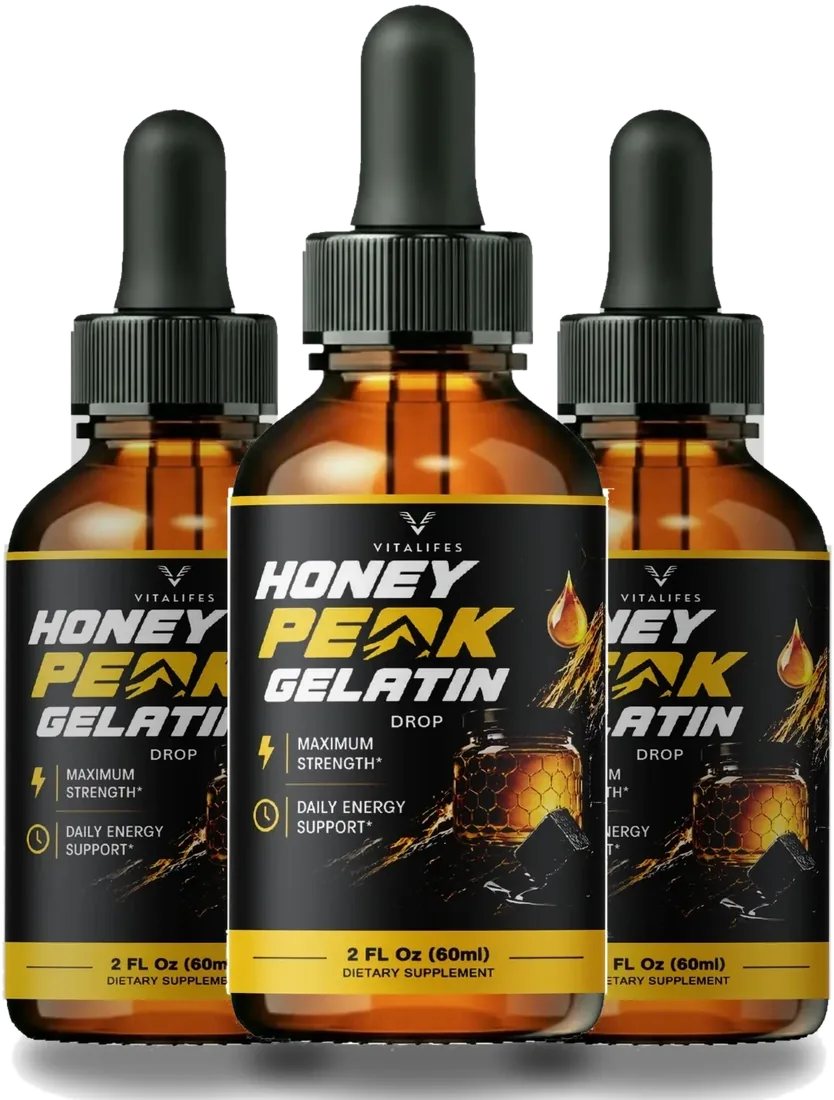
Two bottles cover the 60-day window at 1 ml twice a day. Prices show at checkout, and the written guarantee terms print there too.
We earn money when you buy through our order links. That does not change the price you pay.